The Note on my Door
In the old days professors might tape brief notes on their office doors. Welcome to the future.
Friday, May 11, 2012
Social Media for Journalists presentation
Today I'll be presenting a talk at the Madison SPJ "Social Media for Journalists" training session. Here's a PDF copy of the slides I'll be talking through.
Tuesday, March 27, 2012
Educational Innovation Showcase 2012
For anyone who caught my poster session and/or "flash talk" at this years' UW-Madison "Showcase Event," here is the link to the L&S online internship course that I described: http://interlsinternship.pbworks.com/
You can find out more about how L&S manages and promotes internships at this page on the L&S Career Services web site: http://www.lssaa.wisc.edu/careers/students/internship_prep.html
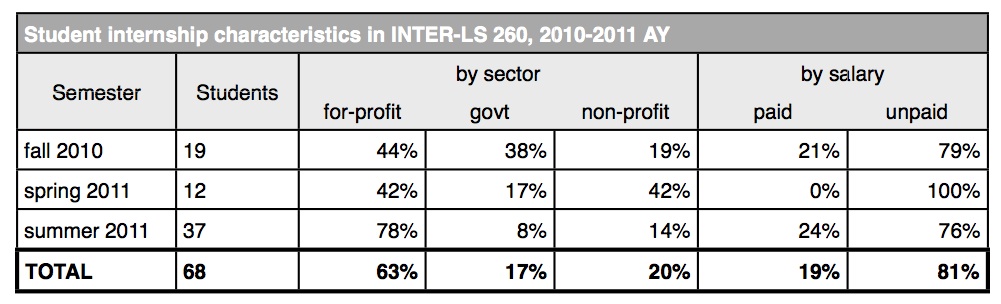
Finally, you can view our latest MIU progress report here: July 2011 The most important data so far is summarized below:
Please let me know if you are interested in becoming a faculty instructor in this innovative program -- we welcome colleagues from all disciplines and departments. (And we actually pay you.) Email me at gdowney@wisc.edu if interested!
You can find out more about how L&S manages and promotes internships at this page on the L&S Career Services web site: http://www.lssaa.wisc.edu/careers/students/internship_prep.html
Finally, you can view our latest MIU progress report here: July 2011 The most important data so far is summarized below:
Please let me know if you are interested in becoming a faculty instructor in this innovative program -- we welcome colleagues from all disciplines and departments. (And we actually pay you.) Email me at gdowney@wisc.edu if interested!
Saturday, March 24, 2012
Read
In my role as the director of a big state university academic department, sometimes high school students email me to ask "What should I be doing to prepare for college and my future career?" Here is what I tell them:
Hi ________, very nice to meet you, and glad you are interested in UW-Madison and our School of Journalism & Mass Communication. Besides the standard advice of keeping your grades up, participating in extra-curricular activities, and staying safe and healthy, the only thing I'd suggest is: READ. Read, read, read. Check out books about communication history, or biographies of people you admire and respect in communication, or even college-level communication textbooks from your school library -- all of these will demonstrate that there are many different pathways to a successful communication career. Purchase an online student-rate subscription to a national newspaper like, say, the New York Times (http://www.nytimes.com/) or visit a free publicly-supported national news source like National Public Radio (http://www.npr.org/) and read the top story in each section every single day. Find a used book store in your city and take an afternoon there trying to figure out the best way to spend five bucks. Read long-form journalism at free aggregator sites like Byliner (http://byliner.com) or Instapaper (http://www.instapaper.com/), from a broad range of newspapers and magazines, on a broad range of topics that you'd normally avoid. Go to your local public library and ask the librarian what new non-fiction book the school teachers and community activists and business entrepreneurs all seem to be talking about, and read that book. Download a free, pre-1923, public-domain novel from Project Gutenberg (http://www.gutenberg.org/) and explore how people lived and talked and dreamed a century ago. Even thick, lush comic books are OK; you can call them "graphic novels" if anyone complains. The more often and more widely and more deeply you read, the better prepared you will be for any college major and any future career. And the better at writing you will become. Best of luck, GREG
Subscribe to:
Posts (Atom)